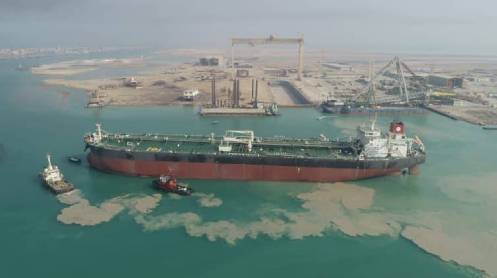
SINGAPORE: Iranian oil exports have begun to recover after several tankers successfully passed through the US naval blockade this week, signaling a gradual restoration of oil flows following a framework agreement between the United States and Iran to reopen the strategically important Strait of Hormuz.
According to shipping and vessel-tracking data, at least three tankers carrying Iranian crude oil have crossed the blockade and are heading toward Asian markets, while a fourth vessel is en route to the Gulf of Oman.
Very Large Crude Carriers (VLCCs) Hero II and Diona, each carrying approximately two million barrels of crude oil, have passed through the Gulf of Oman and are currently sailing eastward, according to data from Kpler and Vortexa.
Meanwhile, the Suezmax tanker Sonia I, carrying around one million barrels of crude, has also crossed the blockade and is heading toward Singapore, based on information from Kpler, Vortexa, and LSEG.
Shipping records show that the cargo aboard Hero II was loaded in late March, while Diona and Sonia I loaded their shipments between April 8 and April 9.
Another Iranian-linked VLCC, Stream, currently without cargo, is reportedly moving toward the blockade zone, indicating that more shipments could soon follow.
The reopening of shipping routes comes after the United States and Iran reached a memorandum of understanding aimed at ending months of conflict and restoring maritime traffic through the Strait of Hormuz, one of the world’s most critical oil transit chokepoints.
A senior US official stated that under the agreement, Washington will immediately allow Iran to resume the sale of crude oil and petroleum products, providing a significant boost to Tehran’s energy exports.
The US blockade, imposed after Iran halted vessel movements through the Strait of Hormuz, had severely impacted the country’s oil exports. According to Kpler data, Iranian crude shipments fell to just 260,000 barrels per day in May, the lowest level in six years and less than one-fifth of the country’s 2025 average export volume of 1.67 million barrels per day.
Market analysts believe the gradual return of Iranian crude supplies could increase global oil availability in the coming months. However, demand from China—Iran’s largest oil customer—has remained relatively weak due to poor refining margins and slower-than-expected industrial activity.
The prospect of additional Middle Eastern oil supplies entering the market has already exerted downward pressure on crude prices. Global oil benchmarks, which surged following the outbreak of conflict on February 28, have recently fallen to three-month lows amid expectations of improved supply conditions and reduced geopolitical risk.
Energy markets are expected to closely monitor the implementation of the US-Iran agreement and the pace at which Iranian exports return to international markets, factors that could significantly influence global oil prices in the weeks ahead.
By Reuters